
Toyota Corolla: Cargo and luggage / Calculation formula for your vehicle
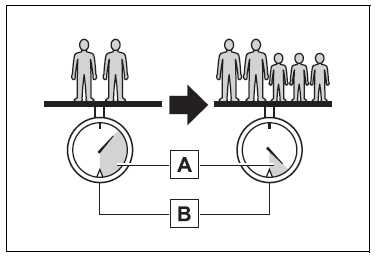
A - Cargo capacity<> B - Total load capacity (vehicle capacity weight)
When 2 people with the combined weight of A lb. (kg) are riding in your vehicle, which has a total load capacity (vehicle capacity weight) of B lb. (kg), the available amount of cargo and luggage load capacity will be C lb. (kg) as follows:
B*2 lb. (kg) - A*1 lb. (kg) = C*3 lb. (kg)
In this condition, if 3 more passengers with the combined weight of D lb. (kg) get on, the available cargo and luggage load will be reduced E lb. (kg) as follows:
C lb. (kg) - D*4 lb. (kg) = E*5 lb. (kg)
As shown in the example above, if the number of occupants increases, the cargo and luggage load will be reduced by an amount that equals the increased weight due to the additional occupants. In other words, if an increase in the number of occupants causes an excess of the total load capacity (combined weight of occupants plus cargo and luggage load), you must reduce the cargo and luggage on your vehicle.
WARNING
■Things that must not be carried in the trunk
The following things may cause a fire if loaded in the trunk:
- Receptacles containing gasoline
- Aerosol cans
■Storage precautions
Observe the following precautions. Failure to do so may prevent the pedals from being depressed properly, may block the driver’s vision, or may result in items hitting the driver or passengers, possibly causing an accident.
- Stow cargo and luggage in the trunk whenever possible.
- To prevent cargo and luggage from sliding forward during braking, do not stack anything in the enlarged trunk. Keep cargo and luggage low, as close to the floor as possible.
- When you fold down the rear seats, long items should not be placed directly behind the front seats.
- Do not place cargo or luggage in or on the following locations.
- • At the feet of the driver
- • On the front passenger or rear seats (when stacking items)
- • On the package tray
- • On the instrument panel
- • On the dashboard
- Secure all items in the occupant compartment.
- Never allow anyone to ride in the enlarged trunk. It is not designed for passengers. They should ride in their seats with their seat belts properly fastened.
■Capacity and distribution
- Do not exceed the maximum axle weight rating or the total vehicle weight rating.
- Even if the total load of occupant’s weight and the cargo load is less than the total load capacity, do not apply the load unevenly. Improper loading may cause deterioration of steering or braking control which may cause death or serious injury.
 Cargo and luggage
Take notice of the following information about storage precautions, cargo capacity
and load:
Capacity and distribution
Cargo capacity depends on the total weight of the occupants...
 Vehicle load limits
Vehicle load limits include total load capacity, seating capacity, towing capacity
and cargo capacity.
Total load capacity (vehicle capacity weight): ®P...
Other information:
Toyota Corolla 2019-2026 Owners Manual: System components
The HomeLink® wireless control system in your vehicle has 3 buttons which can be programmed to operate 3 different devices. Refer to the programming methods on the following pages to determine the method which is appropriate for the device. A - HomeLink® indicator light B - Garage door operation indicators C - HomeLink® icon Illuminates while HomeLink® is operating...
Toyota Corolla 2019-2026 Owners Manual: Indications on multi-information display
A - LDA indicator The illumination condition of the indicator informs the driver of the system operation status. Illuminated in white: LDA system is operating. Illuminated in green: Steering wheel assistance of the steering assist function is operating...
Categories
- Manuals Home
- 12th Generation Corolla Owners Manual
- Sound settings
- Interior features
- Transfer contacts from device
- New on site
- Most important about car
Unlocking and locking the doors from the outside
■ Smart key system (if equipped)
Carry the electronic key to enable this function.
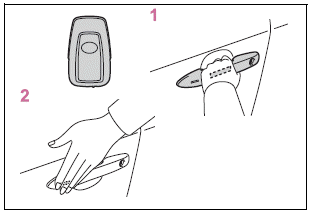
1 Grip the driver’s door handle to unlock the door. Holding the driver’s door handle for approximately 2 seconds unlocks all the doors. Grip the front passenger’s door handle to unlock all the doors.*
